The Challenge
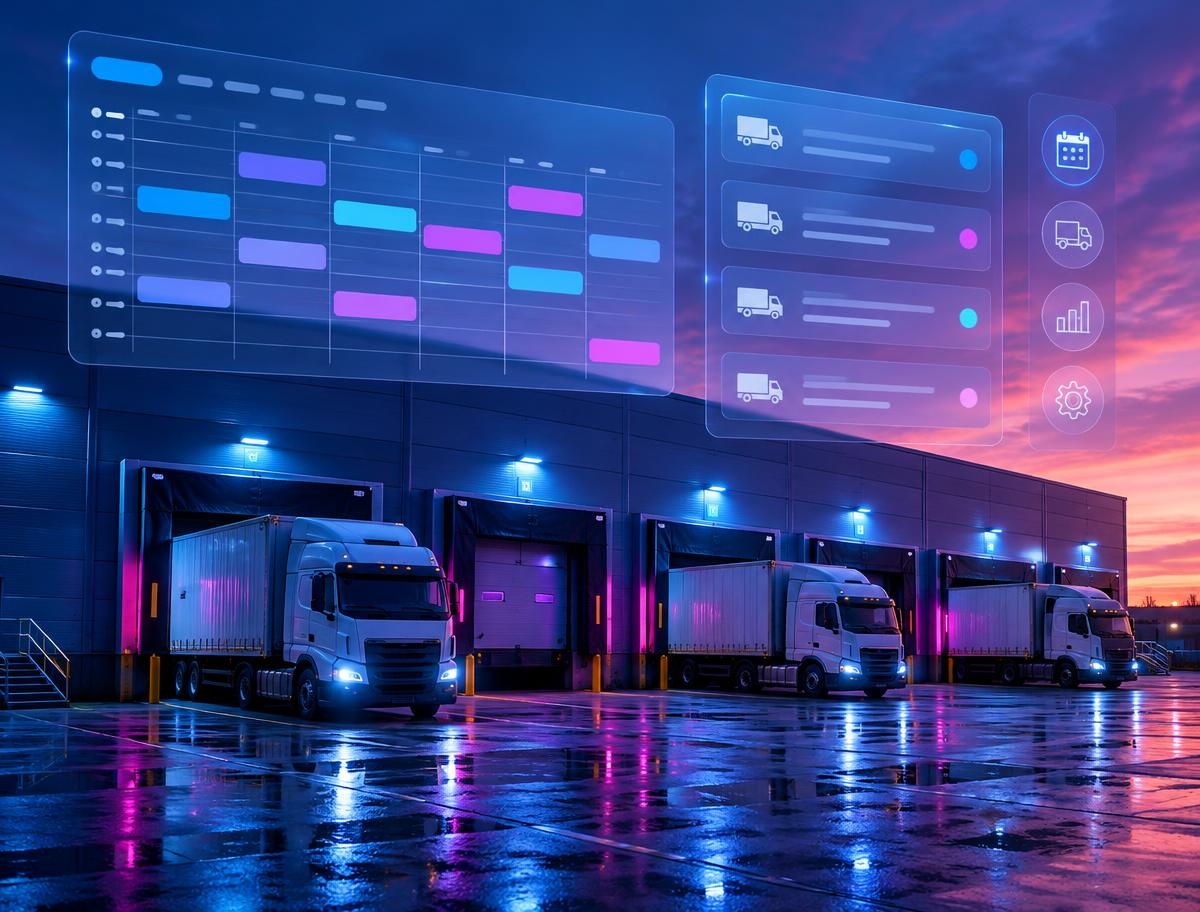
Warehouse dock scheduling involves coordinating multiple participants, facilities, and operational constraints. Transportation providers need a straightforward way to request delivery appointments, while warehouse personnel must manage incoming requests and available dock capacity.
The application needed to support two distinct user experiences:
- Transportation providers: a simple process for requesting unloading appointments at specific facilities, dates, and times.
- Warehouse personnel: a centralized interface for reviewing appointment requests, managing schedules, and administering warehouse facilities and loading docks.
The challenge was to bring these workflows together into an intuitive application while integrating with the customer's existing enterprise systems.
The Solution
I designed and developed a full-stack web application built around the needs of both transportation providers and warehouse operations teams.
Carrier Appointment Requests
A streamlined interface allows transportation providers to submit unloading appointment requests for specific dates and times, making the scheduling process more structured and accessible.
Warehouse Scheduling & Approval
Warehouse teams can review incoming appointment requests, approve and manage appointments, and coordinate dock activity through a centralized interface.
Facility & Dock Administration
Administrative capabilities allow authorized personnel to manage warehouse facilities and their associated loading docks, supporting the operational structure of individual locations.
Enterprise System Integration
The application exposes APIs for exchanging information with the customer's existing systems. The customer's engineering team developed the supporting integration that sends data from its backend to the application's API. This approach allowed the new platform to operate as a focused, independently developed product while connecting to established enterprise infrastructure.
My Role & Technical Approach
I was responsible for the application's end-to-end design and development, from translating business requirements into user workflows through implementation and production deployment. My responsibilities included:
- Product architecture and workflow design
- User experience and interface design
- Frontend application development
- Backend development and API implementation
- Supabase database architecture and integration
- AI-assisted development and iterative prototyping
- Application testing, refinement, and deployment
- Collaboration with the customer's engineering team on enterprise data integration
AI-assisted development tools accelerated implementation and iteration, allowing me to work across design, frontend, backend, and database development without requiring a traditional multi-person application development team.
Throughout the project, the emphasis remained on creating an intuitive, maintainable application that addressed real operational requirements.
The Outcome
The completed application was deployed into production to support warehouse dock scheduling for a global equipment supplier.
It brought carrier appointment requests, warehouse scheduling decisions, and facility administration into a dedicated operational platform, providing a structured way for external transportation providers and internal warehouse personnel to coordinate deliveries.
Beyond the application itself, the project demonstrates a modern approach to enterprise product development: combining senior-level UX expertise, practical software engineering, and AI-assisted development to move from business requirements to a deployed application.
Key Takeaway
Enterprise software doesn't always require a large development team to deliver meaningful results.
By combining UX strategy, product architecture, and hands-on full-stack development, I was able to independently deliver a production application while collaborating with an established enterprise engineering organization on the necessary integrations.